Multi-agent workflows
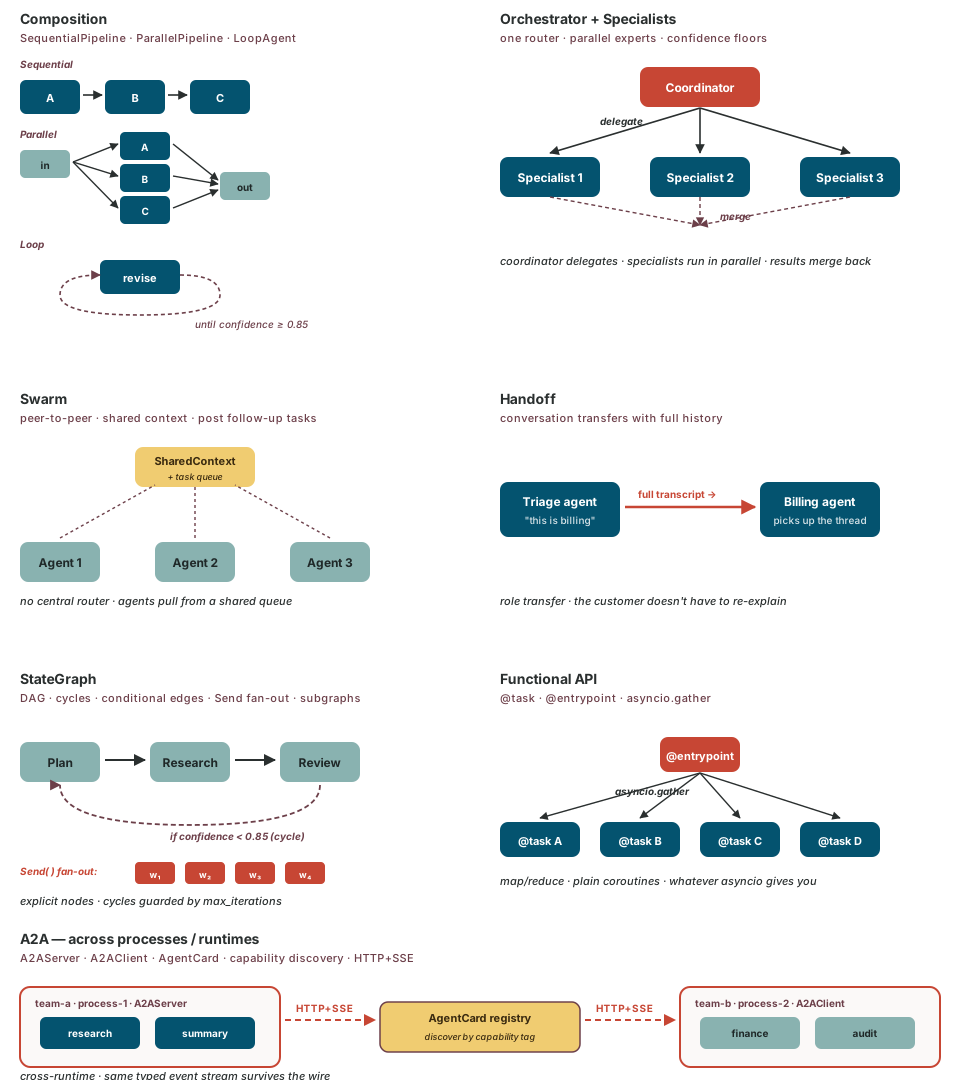
Multi-agent workflows are what locus is for. Seven shapes you compose
in one process or scale across a mesh, every shape backed by the same
Agent class, the same event stream, and the same primitives. Pick a
shape directly, or let the cognitive router select and
compile the right one from a natural-language task description.
Don't know which shape to use?
PRISM — the cognitive router extracts a typed
GoalFrame from your task and selects a matching protocol from a
typed registry. Eight built-in protocols, zero topology hand-writing.
What you can ship today
Every example below is a real examples/tutorial_NN_*.py file in the
repo, runs end-to-end against the bundled MockModel (no creds), and
upgrades to live OCI / OpenAI by setting one env var.
| Workflow | One line | Code | |
|---|---|---|---|
| 41 | DeepAgent — research factory | create_deepagent with reflexion + grounding + subagent dispatch + deepagent.* SSE events. |
tutorial_41_deepagent.py |
| 42 | Map-reduce code review | Scatter a diff to N reviewers via Send, reduce findings into one report. |
tutorial_42_map_reduce_code_review.py |
| 43 | Supervisor + critic loop | Researcher → Writer → Critic, loop back to Writer until critic approves (cap'd revisions). | tutorial_43_supervisor_critic_loop.py |
| 44 | Adversarial debate + judge | PRO and CON argue across N rounds; Judge emits a typed Verdict via output_schema. |
tutorial_44_debate_with_judge.py |
| 45 | Multi-agent + human-in-the-loop | Three patterns in one file: approval gate, human-as-tool, long-pause snapshot/resume. | tutorial_45_multiagent_human_in_loop.py |
| 46 | On-call incident response | Triage → 3 parallel investigators (logs / metrics / traces) → severity gate → page-the-human → mitigate → typed Postmortem. |
tutorial_46_incident_response.py |
| 47 | Tiered approval workflow | Justifier → Vendor analyst → tier router (auto / manager / +finance / +CFO) → typed PurchaseOrder. Three stacked interrupt() gates on the top tier. |
tutorial_47_procurement_approval.py |
| 48 | Contract review + negotiation | Parser → 3 parallel reviewers → negotiation gate → human counsel → Command(goto="sign_off") short-circuits when resolved. Cycles enabled. |
tutorial_48_contract_review.py |
Pick a shape
Three questions get you to the right shape almost every time:
- Do agents need to talk across processes or runtimes? If yes, you want A2A. If no, everything else lives in one Python process.
- Does the flow have cycles or conditional routing? If yes, you want StateGraph. If it's a straight chain or fan-out, you want Composition.
- Do you want one coordinator picking the next agent, or peers collaborating without a central router? Coordinator → Orchestrator + Specialists. Peers → Swarm. A single agent passes the conversation onward → Handoff.
The decision tree below is the same questions in diagram form.
                ┌── do agents need to talk across processes / runtimes? ──┐
                │                                                         │
              yes ──→  A2A                                                no
                                                                          │
                  ┌─── need explicit control flow? ───┐
                  │                                   │
                yes                                   no
                  │                                   │
        ┌─────────┴───────────┐         ┌─────────────┴────────────┐
        │                     │         │                          │
   linear / fan-out       cycles?     central router?         no router
   no cycles               yes          yes                     │
        │                  │            │                       │
   Composition         StateGraph   Orchestrator + Specialists   Swarm
                                                                  │
                                                              one agent
                                                              hands off?
                                                                  │
                                                             yes  │  no
                                                                Handoff
Writing your own glue (asyncio fan-out, retries, schedulers)? Use the
Functional API (@task, @entrypoint) — a thin wrapper that brings
agent runs into the ordinary asyncio universe.
The seven shapes
| Pattern | Best for | Key class | Source |
|---|---|---|---|
| Composition | linear chains; fan-out + merge; revise-until-confidence | SequentialPipeline, ParallelPipeline, LoopAgent |
agent/composition.py |
| Orchestrator + Specialists | one router decides which expert handles each sub-task | Orchestrator, Specialist |
multiagent/orchestrator.py |
| Swarm | open-ended research; peer-to-peer; shared context | Swarm, SharedContext |
multiagent/swarm.py |
| Handoff | escalation desks; conversation moves with full history | Handoff |
multiagent/handoff.py |
| StateGraph | explicit DAG with cycles, conditional edges, subgraphs | StateGraph, Node, Edge |
multiagent/graph.py |
| Functional | map/reduce over agents; asyncio-native composition | @task, @entrypoint |
multiagent/functional.py |
| A2A | cross-process / cross-runtime; capability discovery | A2AServer, A2AClient, AgentCard |
a2a/protocol.py |
Workflow primitives
The pieces every shape is built from. Drop them into any graph node.
Send — scatter / map-reduce
from locus import Send

async def split(state):
    return [Send("worker", {"task": t}) for t in state["tasks"]]
Returning a list of Send from a node spawns parallel executions —
no asyncio.gather, no shared mutable state. Each result lands in
state[send.id] keyed by the send id. Used by tutorials 42, 46, 48.
interrupt() — pause for a human
from locus.core import interrupt

async def approval_node(state):
    response = interrupt({"question": "Ship it?", "options": ["yes", "no"]})
    return {"approved": response == "yes"}
interrupt() raises InterruptException; the graph catches it,
snapshots state, and returns control to the caller. Resume by calling
graph.execute(Command(resume="yes")). Used by tutorials 45, 46, 47, 48.
Command(goto=...) — explicit routing
from locus.core import goto

async def smart_router(state):
    if state["urgent"]:
        return goto("emergency", priority=10)   # skip ahead
    return {"score": compute_score(state)}      # normal flow
Return a Command from a node to override the default edge — useful
for short-circuiting refinement loops or skipping straight to sign-off.
Used by tutorial 48 to skip the negotiation loop when counsel says RESOLVED.
Agent(output_schema=...) — typed terminal artifacts
from pydantic import BaseModel
from locus import Agent, AgentConfig

class Verdict(BaseModel):
    winner: str
    confidence: float
    reasoning: str

agent = Agent(config=AgentConfig(model="oci:openai.gpt-5.5", output_schema=Verdict))
result = agent.run_sync("...")
verdict: Verdict = result.parsed   # validated Pydantic instance, not free text
When you need a typed artifact at the workflow boundary — Verdict,
Postmortem, PurchaseOrder, ContractDecision — output_schema
gives you a validated Pydantic instance. Used by tutorials 44, 46, 47, 48.
GraphConfig(allow_cycles=True) — refinement loops
from locus import GraphConfig, StateGraph

graph = StateGraph(config=GraphConfig(allow_cycles=True, max_iterations=20))
graph.add_edge("critic", "writer")   # loop edge — only legal with allow_cycles
Cycles are off by default (so you can't accidentally infinite-loop).
Opt in with allow_cycles=True plus an iteration cap. Used by
tutorials 43, 48.
Why these workflows ship to prod
The boring stuff that turns a demo into a product. Every primitive below works in any of the seven shapes — you don't pick "shape" or "production-ready", you get both.
Reflexion — catch a bad turn before the next one
reflexion=True self-evaluates every turn and feeds the next Think a
sharper plan. → Reasoning concept
Grounding — verify claims against their source
Each claim is scored against the tool result it came from; below-threshold claims get dropped or sent back. → Reasoning concept · GSAR for typed grounding.
Idempotent tools — side effects fire once
@tool(idempotent=True)
def book_flight(flight_id: str, customer_id: str) -> dict:
    return billing.charge_and_book(flight_id, customer_id)
The ReAct loop dedupes repeat calls on the (name, kwargs) hash — the
model can't double-charge, double-book, or double-page. → Idempotency
concept.
Checkpointing — survive every restart
agent = Agent(config=AgentConfig(
    model=...,
    checkpointer=OCIBucketBackend(bucket="...", namespace="..."),
))
Nine backends — one Protocol — and the graph snapshots state at every interrupt boundary. Pause for a human Friday afternoon, resume Monday morning from a different process. → Checkpointers.
Streaming events — every node visible
async for event in graph.stream(initial, mode=StreamMode.NODES):
    match event:
        case StreamEvent(node_id=n, mode=StreamMode.NODES):
            print(f"✓ {n}")
Every shape in this section emits the same typed events. SSE-ready, match-statement friendly, attributable to the specific specialist that produced them. → Streaming.
One event stream across all of them
All seven patterns plus A2A share the same typed event
taxonomy. Consume directly from the generator, or use the opt-in
EventBus to get per-component SSE events (agent.think,
agent.tool.started, multiagent.orchestrator.routing, etc.)
from every layer simultaneously:
from locus.observability import run_context, get_event_bus

async with run_context() as rid:
    result = orchestrator.run_sync("Plan Q3 launch.")

    async for ev in get_event_bus().subscribe(rid):
        match ev.event_type:
            case "multiagent.orchestrator.decision":
                print("coordinator →", ev.data["specialists_selected"])
            case "agent.tool.started":
                print("  🔧", ev.data["tool_name"])
            case "agent.terminate":
                print("  ✓", ev.data["final_message_preview"])
agent_name is set on every event so you can attribute output to the
specialist that produced it. SSE streams from AgentServer carry the
same shape — your front-end consumer is unchanged whether the back-end
is a single agent, an orchestrator, a swarm, or an A2A mesh.
→ Observability — EventBus & SSE · SSE event catalogue
Mixing shapes
Nothing stops you running a Swarm whose members are themselves
Orchestrators, with a StateGraph wrapping the whole thing for
retry policy. The patterns compose; pick the shape that fits each
layer of the problem.
See also
- Agent Loop — the loop every agent in every shape runs.
- Hooks — observe and steer across all of them.
- Streaming — the typed event taxonomy.