A2A — Agent-to-Agent¶
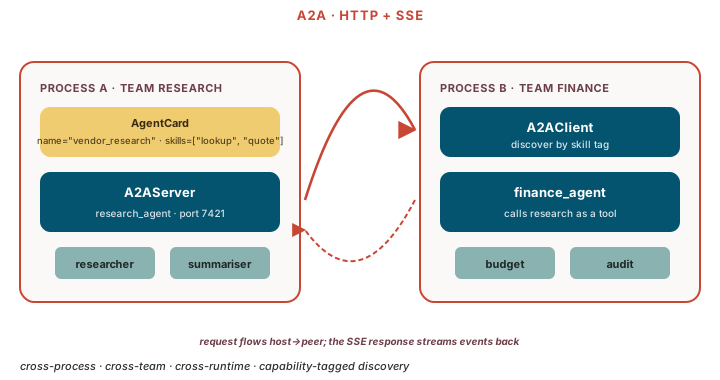
A2A is the cross-process / cross-runtime version of multi-agent. Each agent runs as its own service, advertises an Agent Card (capabilities + skills + endpoint URL) at a well-known URL, and other agents discover and call it over HTTP.
Locus implements the public A2A protocol — the same wire format used by Strands, ADK, and Google's reference SDKs — so a Locus agent can call a non-Locus A2A peer (or be called by one) without an adapter.
Wire surface¶
A2AServer exposes:
| Endpoint | Purpose |
|---|---|
GET /.well-known/agent-card.json |
Public Agent Card — name, description, skills, capabilities, modes (spec §5.5). |
POST / |
JSON-RPC 2.0 method dispatch — message/send, message/stream, tasks/get, tasks/cancel. |
GET /agent-card, POST /a2a/{invoke,stream} |
Backwards-compat aliases for peers that haven't picked up the spec yet. |
The Task lifecycle has eight spec states: submitted, working,
input-required, auth-required, completed, canceled, failed,
rejected. Streaming responses on message/stream arrive as SSE
events of TaskStatusUpdateEvent and TaskArtifactUpdateEvent.
Messages carry typed parts: TextPart, FilePart (inline bytes or
URI), DataPart (structured JSON).
When to use it¶
- ✅ Multi-process or multi-host agent deployments.
- ✅ Different teams own different agents on different stacks.
- ✅ You need a network boundary for security or scaling.
- ✅ Polyglot — a Locus agent calling a non-Locus A2A peer (or vice versa) speaks the same protocol verbatim.
- ✅ Capability-based discovery — the caller reads the Agent Card and decides whether to delegate.
When NOT to use it¶
- ❌ Single-process — use one of the in-process patterns; HTTP round-trips are pure overhead.
- ❌ Tight latency requirements — A2A adds 10–50ms per hop.
- ❌ The peer is always the same agent — just call it directly.
Code¶
Host side — expose an agent over A2A¶
from locus import Agent
from locus.a2a import A2AServer, AgentSkill

research_agent = Agent(
    model="oci:openai.gpt-5.5",
    tools=[search_corpus, summarise, cite],
    system_prompt="You read the vendor catalogue and quote prices.",
)

server = A2AServer(
    agent=research_agent,
    name="vendor_research",
    description="Reads the vendor catalogue. Quotes prices.",
    url="https://research.example.com",
    skills=[
        AgentSkill(
            id="vendor_lookup",
            name="Vendor lookup",
            description="Find vendors by name or capability tag.",
            tags=["catalogue", "vendor"],
        ),
        AgentSkill(
            id="price_quote",
            name="Price quote",
            description="Quote three options for a target spend.",
            tags=["pricing"],
        ),
    ],
    api_key="rotate-this-secret",
)
server.run(host="0.0.0.0", port=7421)
The Agent Card is now reachable at
https://research.example.com/.well-known/agent-card.json (with the
required bearer token).
Client side — fetch the card and send a message¶
from locus.a2a import A2AClient, Message, TextPart

client = A2AClient(url="https://research.example.com", api_key="rotate-this-secret")

# Read the public card to learn the agent's skills + capabilities.
card = await client.get_agent_card()
print(card.name, [s.id for s in card.skills])

# Synchronous send — returns a Task in the `completed` state.
task = await client.send_message(
    Message(
        role="user",
        parts=[TextPart(text="Quote three options for $2M cloud spend.")],
        messageId="m-1",
    )
)
final_text = task.artifacts[-1].parts[0].text
print(final_text)
Streaming¶
async for event in client.send_message_streaming(
    Message(
        role="user",
        parts=[TextPart(text="Quote three options for $2M cloud spend.")],
        messageId="m-2",
    )
):
    if event.get("kind") == "status-update":
        print("status:", event["status"]["state"])
    elif event.get("kind") == "artifact-update":
        print("got artifact")
    elif event.get("kind") == "task":
        print("initial task:", event["id"])
Task lifecycle¶
task = await client.send_message(message)
# Long-running tasks: poll while still in working / input-required.
fresh = await client.get_task(task.id)
if fresh.status.state == "input-required":
    # ... gather input from the human, then send a follow-up message
    ...
# Or cancel.
await client.cancel_task(task.id)
Auth + TLS¶
A2AServer ships with bearer-token auth: pass api_key="..." (or set
LOCUS_A2A_API_KEY) and every route — including
/.well-known/agent-card.json — requires Authorization: Bearer ....
With no key the server refuses non-loopback bindings unless
allow_unauthenticated=True is passed (use that only behind an
upstream proxy that terminates auth). TLS is the standard FastAPI
story — terminate it at your load balancer or via uvicorn's --ssl-*
flags.
Backwards compatibility¶
The pre-spec endpoints are still served:
# Legacy: flat string-in / string-out — bypass the JSON-RPC envelope.
reply = await client.invoke("Quote three options...")
Anything that imported A2AMessage / A2ARequest / A2AResponse from
locus.a2a.protocol keeps working — those models are preserved as
aliases for the legacy /a2a/invoke shape. Spec-aware peers should
use Message + client.send_message() so they can read the full
Task (status, history, artifacts).
Tutorial¶
tutorial_34_a2a_protocol.py
— host + client + streaming.
Source¶
a2a/spec.py
— typed Pydantic models for every spec object.
a2a/protocol.py
— A2AServer, A2AClient, JSON-RPC dispatch, in-memory task store.
See also¶
- Multi-agent overview — pick a shape.
- Agent Server — the in-process FastAPI wrapper that A2A is built on top of.
- Conversation Management —
contextIdflows across A2A so peers share context.