Orchestrator + Specialists
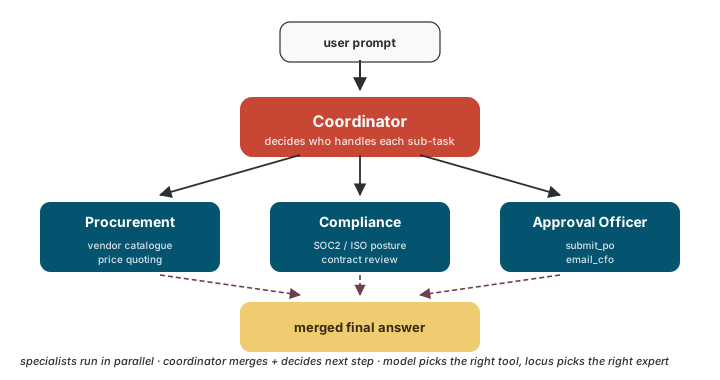
One coordinator picks which specialist handles each sub-task. The specialists never talk to each other — only to the orchestrator. Think project manager + team.
What it is
The coordinator is a regular Agent whose tool-set is the
specialists. Calling a specialist runs that specialist's full
agent loop and returns the answer. When the coordinator dispatches
to multiple specialists in one turn they run in parallel.
Each Specialist has:
- a
name— what the coordinator calls it by - an
agent— the specialist's ownAgent(its own model, tools, system prompt) - a
description— what the specialist is good at (the coordinator reads this) - an optional
confidence_floor— below this the specialist declines
When to use it
- ✅ The work splits cleanly into expert domains (Procurement, Compliance, Approval Officer; or Research, Writing, Editing).
- ✅ You want one place to attribute decisions to — the coordinator.
- ✅ Specialists need their own playbooks, skills, or models (a cheap model for triage, a strong one for compliance).
- ✅ Auditability matters — the dispatch log is your trail.
When NOT to use it
- ❌ The flow is linear, not delegated — use Composition.
- ❌ No central coordinator should exist; agents should self-organise — use Swarm.
- ❌ The conversation itself moves between roles — use Handoff.
Code
from locus.multiagent import Orchestrator, Specialist

procurement = Specialist(
    name="procurement",
    agent=Agent(
        model="oci:openai.gpt-5.5",
        tools=[search_vendors, quote_prices],
        system_prompt="You are the Procurement specialist.",
    ),
    description="Reads the catalogue. Quotes prices. Picks vendors.",
)

compliance = Specialist(
    name="compliance",
    agent=Agent(
        model="oci:openai.gpt-5.5",
        tools=[check_soc2, check_iso, search_legal_terms],
        system_prompt="You are the Compliance specialist.",
    ),
    description="Vets vendors against SOC2/ISO posture. Flags red lines.",
)

approver = Specialist(
    name="approver",
    agent=Agent(
        model="oci:openai.gpt-5.5",
        tools=[submit_po, email_cfo],          # ← idempotent writes
        system_prompt="You are the Approval Officer.",
    ),
    description="Submits the PO and notifies the CFO. Only after approval.",
)

orchestrator = Orchestrator(
    coordinator_model="oci:openai.gpt-5.5",
    specialists=[procurement, compliance, approver],
    system_prompt=(
        "You are the procurement lead. Delegate research to procurement, "
        "vetting to compliance, and only after both agree call approver."
    ),
)

result = orchestrator.run_sync(
    "Pick three vendors for $2M of cloud spend.",
    thread_id="po-q3-2026",
)
What runs in parallel
Specialists fire concurrently when the coordinator dispatches to several of them in one turn. So when the coordinator says "in parallel: procurement, get me three quotes; compliance, vet our existing vendor list" — both specialists run at the same time and their results merge back before the coordinator's next Think.
Confidence floors
A specialist can decline with low confidence. The coordinator sees the decline and tries another expert (or asks the user):
Specialist(
    name="legal",
    agent=legal_agent,
    description="Contract review and risk-flagging.",
    confidence_floor=0.7,    # below 0.7 the specialist returns
                             # ("decline", reason) and the coordinator
                             # routes elsewhere
)
Tutorials
tutorial_17_orchestrator_pattern.py— router + three parallel specialists, results merged.tutorial_18_specialist_agents.py— confidence floors and per-specialist playbooks.tutorial_47_procurement_approval.py— orchestrator-shaped procurement with tiered approval gates and a typedPurchaseOrderartifact.
Source
multiagent/orchestrator.py
— Orchestrator, Specialist.
See also
- Multi-agent overview — pick a shape.
- Handoff — when the conversation itself transfers, not just sub-tasks.
- Playbooks — declarative step plans per specialist.