Handoff
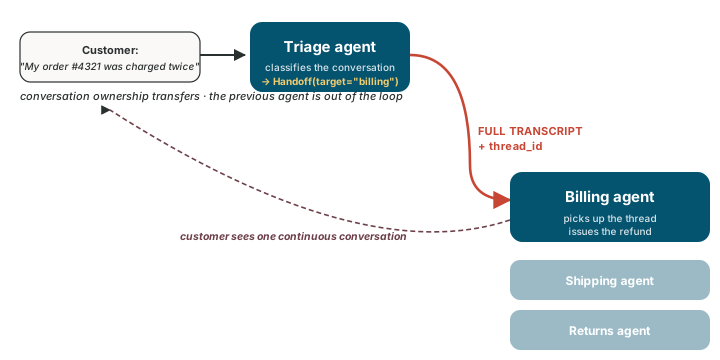
Handoff is what an escalation desk does. One agent owns the conversation, decides it needs a different role, and hands the whole transcript to the next agent — who picks up where it left off.
What it is
A Handoff flow has:
- An
initialagent — the entry point (usually triage). - A
targetsdict — name → agent for each possible next role.
The initial agent ends a turn with a Handoff(target="billing")
directive. The full message history transfers; the billing agent
reads it as if it were the next turn of the same conversation.
State, checkpointer, and thread_id survive.
When to use it
- ✅ Customer-support flows where the conversation is the unit of work.
- ✅ "Pass to a human" — the human simply replaces one of the targets.
- ✅ Escalation when the first agent realises it's the wrong specialist (after a few turns of conversation, not on first read).
- ✅ The customer should not have to re-explain when control transfers.
When NOT to use it
- ❌ The coordinator delegates a sub-task and waits for the answer (the conversation belongs to the coordinator) — use Orchestrator instead.
- ❌ Multiple agents should process the conversation in parallel — use Composition or Swarm.
- ❌ The flow is fully scripted — handoff is for cases where the routing emerges from the conversation.
Difference vs Orchestrator
| Handoff | Orchestrator | |
|---|---|---|
| Conversation owner | moves between agents | stays with the coordinator |
| Routing decision | the agent that's currently in charge | always the coordinator |
| Specialist's view of history | full transcript | just the sub-task they were dispatched for |
| Customer-facing? | usually yes | usually no |
Code
from locus.multiagent import Handoff

triage = Agent(
    model="oci:openai.gpt-5.5",
    tools=[lookup_order, lookup_account],
    system_prompt=(
        "You triage incoming customer messages. "
        "Identify whether this is a billing, shipping, or returns issue. "
        "Then call Handoff(target=...)."
    ),
)
billing = Agent(
    model="oci:openai.gpt-5.5",
    tools=[issue_refund, retry_charge],
    system_prompt="You handle billing escalations.",
)
shipping = Agent(
    model="oci:openai.gpt-5.5",
    tools=[track_shipment, request_redelivery],
    system_prompt="You handle shipping issues.",
)
returns = Agent(
    model="oci:openai.gpt-5.5",
    tools=[create_return_label],
    system_prompt="You handle returns.",
)

flow = Handoff(
    initial=triage,
    targets={"billing": billing, "shipping": shipping, "returns": returns},
)

result = flow.run_sync(
    "My order #4321 was charged twice.",
    thread_id="cust-c42-2026-04",
)
What persists across the handoff
state.messages— the full conversation history.state.tool_executions— including idempotency hashes, so the next agent won't re-fire a write the previous agent already ran.state.metadata— your application's per-conversation data.thread_id— same thread, just a different agent driving.
The receiving agent picks up the same loop. It does not see the handoff as a "new turn"; it sees the previous transcript and the customer's last message.
Tutorials
tutorial_16_agent_handoff.py— full triage + billing + shipping + returns escalation flow.tutorial_45_multiagent_human_in_loop.py— handoff to a human viainterrupt()(one of three HITL patterns in the same file).
Source
See also
- Conversation Management — how the thread is checkpointed across the handoff.
- Multi-agent overview — pick a shape.