Swarm
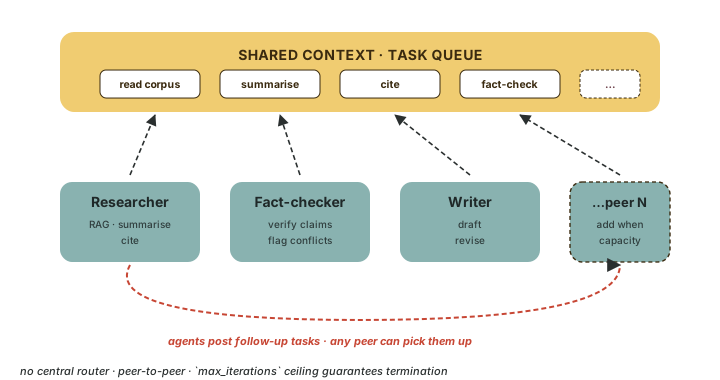
A swarm is a peer-to-peer task pool. Agents pull tasks off a shared queue, run them, and may post follow-up tasks for any peer to pick up. Nobody is in charge.
What it is
Three pieces:
- A
SharedContext— a dict every agent reads and writes. - A task queue — agents pull from it; agents push to it.
- N agents — each with its own tools and system prompt.
Each iteration, every available agent picks the next task it's
qualified for, runs it, and may emit follow-up tasks. The swarm
exits when the queue empties or max_iterations is hit.
When to use it
- ✅ Open-ended research — no fixed plan; whatever an agent finds may spawn new sub-tasks.
- ✅ Heterogeneous specialists — each agent has different tools but any of them can pick up the next task they're qualified for.
- ✅ Long-running batch — a queue depth + a max-iteration budget is the natural shape.
- ✅ No single coordinator should exist — peer-to-peer is the point.
When NOT to use it
- ❌ The flow is actually linear → use Composition.
- ❌ One agent should decide who runs → use Orchestrator.
- ❌ The conversation transcript should follow one role to another → use Handoff.
- ❌ You need strict execution order — swarms run agents concurrently by design.
Code
from locus.multiagent import Swarm

researcher = Agent(
    model="oci:openai.gpt-5.5",
    tools=[search_corpus, summarise],
    system_prompt="You are a researcher. Read, summarise, post follow-ups.",
)
fact_checker = Agent(
    model="oci:openai.gpt-5.5",
    tools=[verify_claim, search_corpus],
    system_prompt="You are a fact-checker. Verify claims, flag conflicts.",
)
writer = Agent(
    model="oci:openai.gpt-5.5",
    tools=[draft, revise],
    system_prompt="You are a writer. Take vetted summaries, draft prose.",
)

swarm = Swarm(
    agents=[researcher, fact_checker, writer],
    shared_context={"topic": "Q3 launch", "audience": "exec summary"},
    max_iterations=12,
    initial_tasks=["read corpus", "summarise top sources"],
)

result = swarm.run_sync()
print(result.final_artefact)
How agents post follow-up tasks
Each agent's tool surface includes (implicitly) a post_task(...)
mechanism. When an agent finishes, it can append new tasks to the
shared queue:
# inside a tool the agent calls
@tool
def summarise_and_followup(text: str, ctx: ToolContext) -> dict:
    summary = summarise(text)
    if has_uncited_claims(summary):
        ctx.swarm.post_task(f"verify claims in: {summary[:200]}…")
    return {"summary": summary}
The next iteration, any qualifying agent (here — the fact-checker) picks up that task.
Termination
Swarms stop when:
- The queue empties and no agent emits new tasks, OR
max_iterationsis hit, OR- A custom
terminatecondition matches (the swarm honours Termination algebra the same way anAgentdoes).
Tutorial
tutorial_11_swarm_multiagent.py
— a three-agent research swarm with shared context.
Source
multiagent/swarm.py
— Swarm, SharedContext.
See also
- Multi-agent overview — pick a shape.
- Orchestrator — when you DO want a router.
- Termination — composable stop conditions.